Water Supply Resilience - Plains
Drinking Water Resilience on the Hauraki Plains
We all rely on safe drinking water. Safe potable water is not only critical for life but also supports the economy of the Hauraki Plains – and by extension the whole District.
The Plains Water Supply System was not originally designed for on-demand use. Recent upgrades to our water supply network allows for on-demand supply to urban homes.
However, some rural properties and high-water users, such as dairy farms are on a restricted supply where we cannot always guarantee the level of flow and pressure. We recommend these properties store 24 hours’ of water as backup supply.
Drinking Water Resilience on the Hauraki Plains
Summary of Information
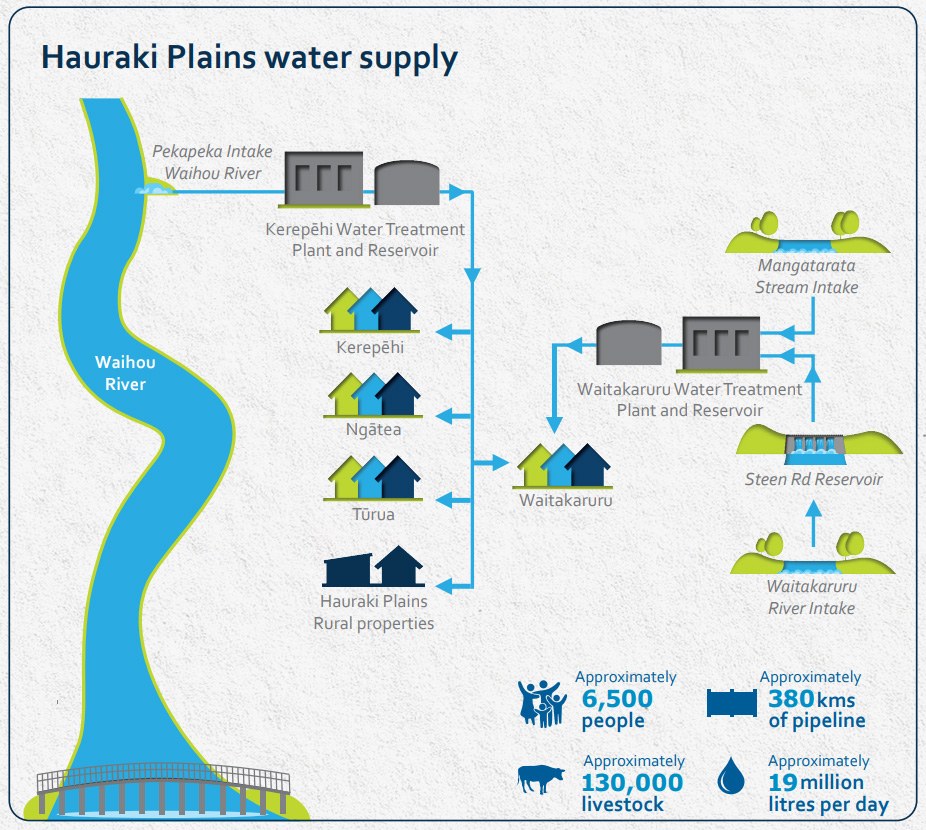
- The Hauraki Plains has 2 water treatment plants, providing 19 million litres per day to 6,500 people and approx. 110, 000 cows and other livestock.
- The pipe network used to deliver the treated water is 364km long with 224km of that being classed as brittle (iron, asbestos and concrete) pipes.
- We have started a pipe renewal programme to upgrade the brittle pipes.
- Water is supplied on-demand for urban properties and 24 hour supply for rural properties.
- Droughts and earthquakes are a big risk to our supply for both rural and urban properties.
- Rural properties should have 24 hours of water supply storage to help prepare their water supply for emergencies
What are the risks?
To ensure a reliable drinking water supply, farms and rural properties must be prepared for demand fluctuations, drought conditions, and earthquake disruptions.

Peak Demands
To ensure you have water during peak demand periods, rural properties and farms should maintain at least 24 hours of on-site storage.
While HDC can supply the 24-hour demand, we may not be able to meet peak demand in rural areas. In the event of an extended disruption to the HDC water supply, water tankers may be available to help top up your storage tanks
Droughts
During drought conditions, the river levels drop significantly. Water extraction becomes challenging, restricting our ability to meet peak demand.
Drought conditions can also affect the integrity of our water network. As clay soils dry and contract, cracks can form around pipes. These soil movements can lead to undetected fractures inside the pipes. Even significant breaks can remain hidden, particularly when they occur in out-of-sight areas, with water dispersing vertically without visible surface indicators.
Drought conditions remain a significant risk, and it is essential that we all contribute to water conservation efforts. See our practical water-saving tips at Smart Water Use.
Earthquakes
The Kerepēhi fault line runs generally north-south through the Plains and extends into the Firth of Thames.
Even a small earthquake could cause damage to some of our pipes. A larger earthquake may result in significant damage to intake structures, raw water tanks, water treatment plants, treated water reservoirs, booster pump stations, and our networks. This could lead to a substantial, if not complete, loss of treated water supply for all of our communities.

Be Prepared
Report a leak
HDC actively monitors water leaks through our leak detection programme, but we rely on your support to identify and report leaks in the network. If you notice a leak, please
- report it via Antenno,
- call us at 07 862 8609 or 0800 734 834 (within the district),
- or submit a report online
Antenno
Be informed. Get involved.
For real-time updates, and notices, and to report water issues and leaks, download Antenno. You can easily provide the location of the leak and photos to help us address the issue promptly.
Find out more about Antenno
In an emergency
Emergencies can happen anytime, anywhere. Be prepared by having water for 3 days. You can take steps to be prepared by visiting www.getready.govt.nz
Improving our water resilience
- The Water Supply Pipe Renewals programme will upgrade and replace the aging infrastructure throughout the district. Replacements are prioritised based on network criticality.
- Hauraki District Council is busy with the commissioning of two new raw water tanks at the Kerepēhi water treatment plant. The new tanks will add around 4 million litres additional storage. This will significantly reduce the risk of a raw water shortage that can occur in severe weather events.
- The existing Kerepēhi raw water main from the Pekapeka intake is also being replaced. These pipes have reached their end of life and the renewal will increase resilience in the network and provide security of the supply. A total of 5.3 kilometres of a 630mm diameter raw water intake pipe will connect to the two new raw water tanks.
- For more information on our ongoing projects, visit our Kōrero Mai Let’s Talk website
Watch a timelapse video of the Kerepēhi raw water storage reservoirs being built...